
Ballet guides
Ballet – training for body and mind
Dance and ballet develop a child’s body while also stimulating attention, memory, coordination, emotions and learning.
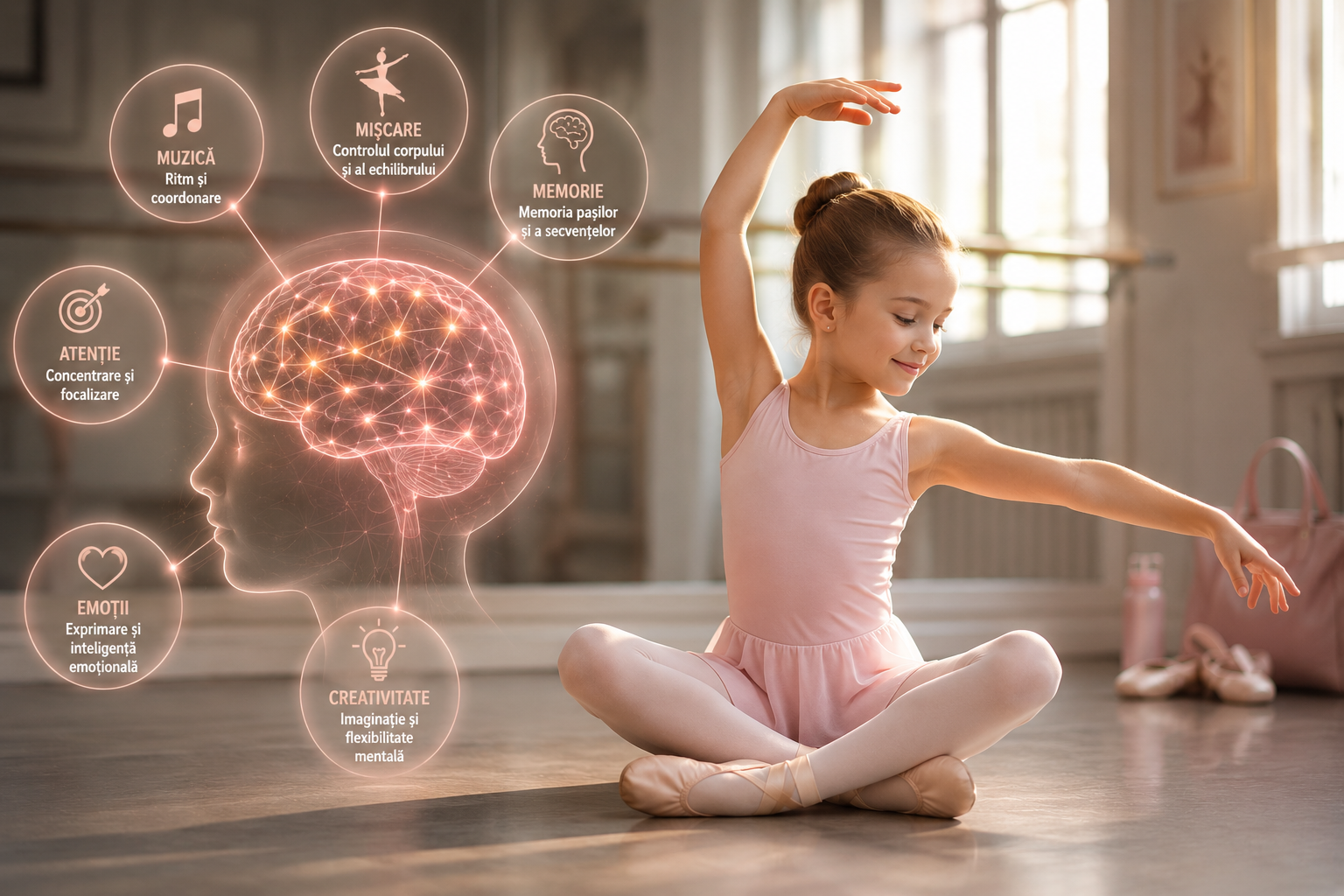
A growing body of neuroscience research shows that artistic activities practised from an early age have a profound impact on children’s brain development.
Dance and ballet are forms of artistic expression and recreation that also provide complex training for the brain, engaging movement, emotions, memory and attention at the same time.
In the first years of life, a child’s brain develops rapidly. Experiences shape its structure and neural connections. Activities that engage both body and mind, such as dance, can therefore play an important role in intellectual development.
The child’s brain and its ability to adapt
One of the brain’s fundamental characteristics is neuroplasticity: its ability to create and reorganise neural connections in response to experience.
When a child practises dance or ballet, the brain coordinates several processes at once:
- Listening to music
- Synchronising movement with the rhythm
- Remembering sequences of steps
- Controlling balance and posture
These activities simultaneously engage several brain regions involved in coordination, memory and learning. Over time, this repeated stimulation contributes to more efficient neural connections.
Dance and the development of attention
A child studying ballet learns to pay attention to details: body position, musical rhythm, classmates’ movements and the teacher’s instructions.
This process trains the brain’s executive functions: the cognitive abilities that help us focus, plan and control our behaviour.
These skills are essential for success at school because they support:
- Concentration
- Working memory
- Organising thoughts
Through repeated choreography and the discipline of training, a child gradually develops self-control and perseverance.
Memory in movement
Dance involves a particular type of memory: procedural memory, or memory for movements.
When children repeat dance steps or choreographic sequences, the brain learns to store these movements so they become automatic.
This process also stimulates other forms of memory, including those associated with academic learning. Activities combining movement and rhythm can support learning and the retention of information.
Developing emotional intelligence
Dance is also a way to express emotions. Through movement, children learn to convey feelings, interpret music and express their personalities.
In this way, dance can contribute to emotional intelligence, helping children understand their feelings and interact more effectively with others.
Body and mind: an inseparable relationship
Modern neuroscience increasingly emphasises the importance of movement in cognitive development. The brain works together with the body: physical activity stimulates processes involved in thinking, memory and creativity.
Dance is one of the few activities that combines all of the following at once:
- Complex movement
- Music
- Memory
- Coordination
- Emotional expression
This combination makes it an effective tool for stimulating intellectual development.
Conclusion
Practised from an early age, dance and ballet can have a significant impact on a child’s development. By stimulating coordination, memory, attention and emotions, these activities contribute to balanced cognitive, emotional and social development.
Beyond its artistic and physical benefits, dance becomes a form of “brain training” that helps children grow in confidence, discipline and their ability to learn.